

5G Core Network Vendor: Key Factors for Choosing the Right Partner
2026-09-22
Choosing a 5G core vendor is less like picking a supplier and more like choosing a co-pilot for the next decade of your network. The wrong call can stall innovation, drain budgets, and leave you scrambling when standards evolve. So how do you separate true partners from those still selling 4G-era thinking? We've distilled the key factors — from cloud-native readiness to deployment flexibility — and looked at how vendors like IPLOOK are resetting expectations.
Cloud-Native Maturity: Containers Alone Don't Cut It
Many teams mistake the presence of containerized workloads for a finished cloud-native journey. They package services into images, schedule them on Kubernetes, and assume the architectural shift is complete. But running containers is only the first step on a longer path. True maturity arrives when the surrounding operational fabric—policy enforcement, observability, cost governance, and resilience patterns—is woven into the platform itself, not bolted on after the fact. Without that depth, what looks like modernization is often just virtualization with extra layers of indirection.
The gap becomes visible under pressure. A system that merely runs containers still depends on manual intervention for rollout decisions, traffic shifting, and failure recovery. It lacks the feedback loops that let engineering teams understand whether a release actually improved user experience or simply kept the pods alive. Cloud-native maturity means the platform handles those concerns as defaults: progressive delivery is the norm, telemetry is queryable without heroic effort, and every deployment carries an implicit contract about how it scales, fails, and spends money. Organizations that stop at containerization miss the part where the platform starts making the right thing the easy thing.
Maturity also shows up in how teams respond to change. Container-first shops often freeze when a service needs to move between clouds, adopt a new data store, or split into event-driven components. The container image travels fine; the operational assumptions around it do not. A mature cloud-native estate treats infrastructure as a programmable surface—load balancers, secrets, quotas, and security boundaries are all version-controlled and reproducible. That stance lets a team rebuild an entire environment in an afternoon instead of spending a quarter fighting drift. Containers alone give you a faster horse; maturity is building the car.
Security Architecture: Zero Trust Meets 3GPP
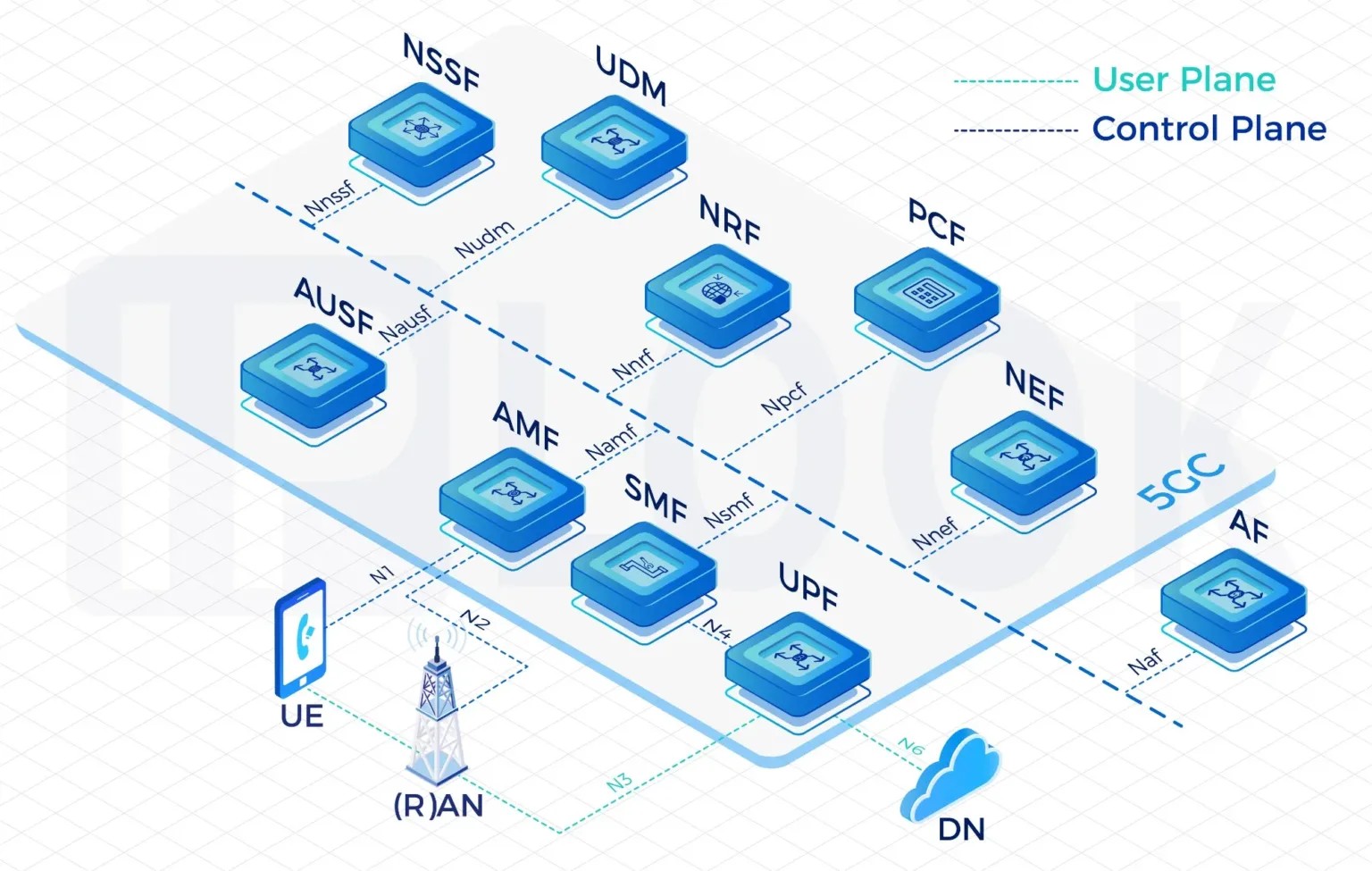
The collision of zero trust with 3GPP architecture isn't about replacing existing security mechanisms but re-anchoring trust assumptions at every network function boundary. In a 5G core, service-based interfaces (SBI) already enforce mutual TLS and OAuth2 tokens, yet zero trust pushes further: each API call from an AMF to an SMF or from an NRF to an NEF must carry explicit, continuously evaluated authorization context, not just network-layer identity. This means policy engines must understand 3GPP-specific attributes like SUPI, DNN, slice identifiers, and NF type, turning coarse perimeter checks into per-transaction decisions.
Roaming scenarios expose the sharpest edges. The SEPP at the edge of a visited network terminates N32 connections, but a zero trust posture demands that even after TLS termination, every cross-operator message is inspected against agreed security policies, with rate limiting and content filtering applied per roaming partner. Traditional 3GPP relies on bilateral agreements and encrypted tunnels; zero trust adds dynamic risk scoring based on real-time threat intelligence and observed behavior, allowing an operator to throttle or block a specific NF consumer even if its certificate remains valid.
On the transport side, legacy GTP-U still carries user plane traffic across N3 and N9 interfaces with minimal built-in authentication. Wrapping those tunnels in IPsec is common, but zero trust would advocate for per-session encryption and integrity protection at the application layer, possibly through DTLS or QUIC, along with continuous validation that a gNB or UPF is authorized to handle a particular PDU session. This shifts the model from 'secure the pipe' to 'secure each flow,' aligning with 3GPP's own evolution toward enhanced user plane protection in Release 18 and beyond.
Multi-Vendor Interop: Testing Real Traffic, Not Just Specs
Interoperability tests often boil down to checking boxes against written specifications, but real-world network traffic doesn't care about your compliance checklist. At our lab, we've seen devices pass every conformance suite yet stumble when hit with mixed vendor streams, unexpected retransmissions, or a sudden burst of multicast. That's why we stopped relying solely on spec sheets and started replaying captured packet captures from live enterprise networks — the kind with fragmented UDP, overlapping VLAN tags, and malformed headers that would never appear in a tidy test harness.
The difference is stark. One access point from a major vendor sailed through its own certification but dropped 12% of VoIP frames when a competing brand's switch introduced a slight jitter pattern. Another firewall claimed full BGP support, yet couldn't maintain a session when route reflectors from two different manufacturers exchanged updates with non-standard community strings. By feeding actual production traffic into our multi-vendor testbed, we uncover these hidden incompatibilities in hours, not weeks of reading RFCs.
We also go a step further: we record traffic between three or more vendors simultaneously, because pairwise testing rarely exposes the cascading failures that occur when vendor A's QoS markings interact with vendor B's queuing algorithm and vendor C's deep packet inspection. Real traffic is messy, asymmetrical, and full of surprises — and that's precisely what your network will face on a Tuesday afternoon. So we test with that, not just with idealised spec-driven scenarios.
Automation and AI Ops: From Day One, Not as an Add-On
Too many teams treat automation and AI-driven operations as a late-stage enhancement. They build, deploy, and run systems manually for months or years, then scramble to bolt on monitoring, auto-remediation, and predictive analytics once incidents become unmanageable. That approach usually backfires. The integrations feel fragile, the data models are incomplete, and the team never fully trusts the automation. Starting from day one means embedding operational intelligence into the initial architecture—defining logs, metrics, and traceability as first-class requirements, not afterthoughts.
Practical implementation starts small but early. Infrastructure as code, automated test pipelines, and synthetic health checks can be part of the first sprint. Even before the first production release, the team can set up anomaly detection on deployment metrics and build runbooks that trigger automatically. The value compounds quickly: fewer manual toggles, faster root-cause analysis, and a baseline of consistent behavior that makes future AI-assisted decisions far more reliable. You're not retrofitting intelligence onto a messy system; you're growing it alongside the code.
This shift is more cultural than technical. When developers, operators, and SREs collaborate from the initial design session, they naturally choose observability-friendly patterns and avoid siloed tooling. The result isn't just an automated stack—it's a system that learns and adapts as it scales. Automation and AI ops become part of the product's DNA, not a patch applied after the pain arrives.
The Real Cost of Licensing at 5G Scale
When 5G moved from lab trials to nationwide rollouts, licensing stopped being a line item and started behaving like a tax on every connection. The sheer number of standard-essential patents tied to 5G—spread across chipmakers, network vendors, and device manufacturers—means a single base station can require royalty stacks from a dozen different rights holders. Unlike earlier generations where a handful of dominant players set predictable rates, 5G's licensing landscape is fragmented, with overlapping claims and per-unit fees that quietly erode margins before a single bit of data is transmitted.
The real cost isn't just the royalty itself; it's the infrastructure needed to manage compliance. Telecom operators now maintain legal teams, patent analysts, and licensing negotiation workflows that rival their RF engineering departments. Every new radio unit, every software-defined feature, and every IoT module triggers a fresh round of audits, disputes, and retroactive settlement demands. This administrative drag scales with network density, so a dense urban deployment can see licensing overhead outweigh the cost of certain hardware components.
For smaller carriers and private network builders, the burden is even sharper. They lack the patent portfolios to cross-license or the litigation budgets to challenge inflated rates, forcing many to accept bundled fees for technologies they may never fully utilize. The result is a quiet consolidation of 5G innovation—where only the largest players can afford to deploy at scale, and the promise of open, competitive connectivity gets priced out before it reaches the market.
Roadmap Credibility: Delivered Features vs. Future Promises
A roadmap is easy to draw and hard to honor. What actually separates a credible product team from a hopeful one is the trail of shipped functionality behind them. I tend to look at the last three release cycles before I even glance at what’s promised for the next two. Past delivery is the only honest predictor we have.
Future promises often come wrapped in vague language like Q3 or coming soon, with no defined scope or acceptance criteria. Delivered features, by contrast, can be tested against real workflows today. If a company has a pattern of slipping deadlines or quietly dropping announced items, that pattern doesn’t reset just because the new roadmap slide looks prettier.
A practical way to weigh a roadmap is to give delivered features most of the score and treat future promises as bonus points that only count once a public beta or early access build appears. Don’t postpone a buying decision or an architecture change based on a feature that exists only in a presentation. If you need something now, judge the product as it is, not as it might become.
FAQ
Look beyond marketing claims and demand evidence of real cloud-native implementation. A vendor should demonstrate containerized network functions with stateless design, service mesh integration, and continuous delivery pipelines built on CI/CD. Also verify commercial readiness of 3GPP Release 16, 17, and 18 features such as enhanced URLLC and improved eMBB slice isolation. Open northbound APIs are essential for enterprise application integration, so ask for concrete API specifications rather than vague promises.
Cloud-native architecture determines how fast your network can scale, heal, and upgrade in production. A genuine cloud-native core should allow network function instances to scale in minutes, not hours, and support unified orchestration across multiple cloud environments. Avoid vendors that simply repackage monolithic software into containers; request a live demonstration of Kubernetes-based deployment, including rolling upgrades and automatic failover.
Network slicing lets you partition a single physical network into logical networks tailored for different vertical industries, such as ultra-low latency for factory automation and high bandwidth for consumer video. The key is automated slice lifecycle management, strong isolation between slices under resource contention, and end-to-end coordination from terminal through radio access to the core. Without these, slicing remains a slideware feature rather than a revenue enabler.
Automation directly impacts operating costs and service agility. You need a vendor that supports intent-driven closed-loop operations where the network adjusts resources based on business intent without manual tickets. Evaluate adherence to ETSI ZSM (zero-touch network and service management) principles and check whether programmable APIs allow operators to define custom policies without vendor intervention.
5G core standards evolve every six months, so a vendor's follow-through on new releases protects your investment. Do not judge only by current feature lists. Investigate the vendor's participation depth in 3GPP SA2 and SA3 working groups, and examine whether the software architecture can add new network functions via plugins or microservices without a major version upgrade. Also ask for a concrete Release 18 and 19 roadmap, particularly around embedded AI/ML for network optimization.
Interoperability is frequently underestimated. The new core must coexist with existing 4G EPC, IMS, billing systems, and third-party policy control platforms. Request interoperability test reports between the vendor and major radio access network suppliers, especially for the N26 interface for 4G/5G interworking and N2/N4 interface maturity. If you already run an SDN controller, confirm the core can connect through standard southbound protocols instead of proprietary extensions.
Security goes far beyond encryption. The service-based architecture of 5G core introduces HTTP/2 and REST APIs, widening the attack surface. A strong vendor should embed zero-trust policies including mutual TLS between microservices, anomaly detection at the API gateway, and native integration with telecom-grade threat intelligence feeds. Also review their patch response times and independent compliance certifications such as GSMA NESAS/SCAS.
Pay close attention to long-term licensing and scaling costs. Some vendors offer low initial quotes but charge steeply for every million additional subscribers or higher transactions per second. On support, examine the geographic distribution of technical assistance centers, average on-site engineer response times, and whether training and documentation allow your own team to make changes independently. Ensure that commitments to open interfaces are written into the contract to avoid later lock-in through private extensions.
Conclusion
Choosing a 5G core vendor means looking past marketing decks. A containerized control plane doesn't automatically deliver cloud-native behavior—stateless design, graceful failure handling, and in-service upgrades are what separate real maturity from a Kubernetes wrapper. Security can't be bolted on; it needs to blend zero-trust principles with 3GPP's own specs, so that NF-to-NF traffic is authenticated and encrypted without breaking lawful intercept or roaming. Then there's interoperability. Lab tests based on written specs hide the messy reality of multi-vendor networks. You want a vendor that has run live, multi-session traffic across at least two other RAN and IMS suppliers, catching edge cases around handover, QoS, and policy enforcement before they hit your production.
Licensing at 5G scale is another silent budget killer—per-session, per-subscriber, or throughput-based models can spiral once you move beyond trials. Ask for a three-year cost model with realistic subscriber and traffic growth, not just year-one pricing. Automation and AI ops should be part of the initial release, not a roadmap slide: closed-loop healing, intent-based scaling, and anomaly detection need to work with your existing OSS/BSS from day one. Finally, judge the roadmap by what has shipped recently. Pick two or three features the vendor claims are 'coming soon' and pressure them for GA dates, field references, and release notes. A credible track record of delivered 5G core features beats a glossy vision every time.
Contact Us
Contact Person: Shimmy
Email: [email protected]
Tel/WhatsApp: 85253392231
Website: https://www.iplook.com