
Can a 3.99 Inch Long Strip LCD Module Interface RGB Run Directly from a 3.3V GPIO with 18-Bit RGB Parallel
2026-08-07
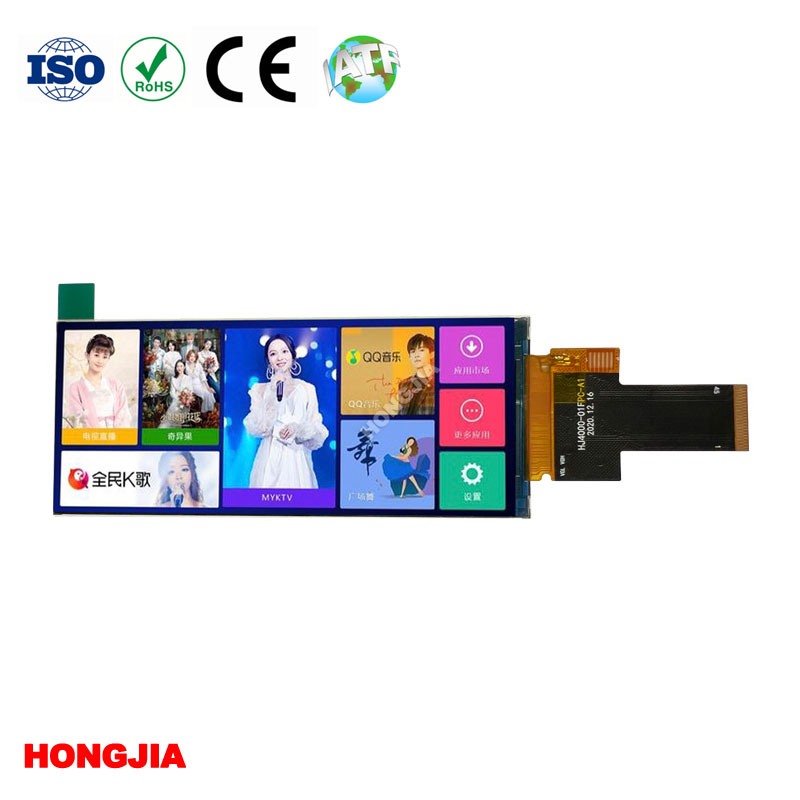
When designing embedded displays, engineers often face a critical voltage compatibility question. The 3.99 inch Long Strip LCD Module Interface RGB is a popular choice for automotive dashboards, smart home panels, and industrial HMI due to its unusual 10:1 aspect ratio. However, most modern MCUs—like ESP32, STM32F4, or i.MX RT—operate at 3.3V logic, while many RGB parallel interfaces historically expected 5V. This blog post, brought to you by HONGJIA, dissects whether a direct 3.3V GPIO connection is feasible for an 18‑bit RGB parallel interface on this specific module, without any level shifter in between.
The Core Voltage Dilemma
The 3.99 inch Long Strip LCD Module Interface RGB typically specifies a logic high input (VIH) of 0.7×VDD and a logic low (VIL) of 0.3×VDD. If the module’s internal I/O supply (VDD) is 3.3V, then VIH ≥ 2.31V—easily met by a 3.3V GPIO (which outputs ~3.0–3.3V). But if VDD is 5V, VIH jumps to 3.5V, which a 3.3V GPIO cannot reliably drive. The first step is always: check the module datasheet for VDD range.
| Parameter | 3.3V MCU GPIO | 5V‑Tolerant LCD (VDD=5V) | 3.3V‑Powered LCD (VDD=3.3V) |
|---|---|---|---|
| VOH (min) | 2.9V | N/A (input expects 3.5V) | 2.31V (VIH) – OK |
| VOL (max) | 0.4V | 0.8V (VIL) – OK | 0.99V (VIL) – OK |
| Direct connection | Risky for HSYNC/VSYNC/DE | Safe for all 18 data lines + sync |
HONGJIA recommends measuring the actual LCD VDD pin before wiring. Many 3.99 inch Long Strip LCD Module Interface RGB variants from HONGJIA now offer a 3.3V‑compatible I/O bank option—always verify the suffix code.
18‑Bit RGB Parallel: Signal Integrity Matters
18‑bit parallel RGB uses 6 bits per color (R0–R5, G0–G5, B0–B5) plus HSYNC, VSYNC, DE, and PCLK—totalling 22 signals. At pixel clocks (PCLK) above 20 MHz, even a 3.3V‑compatible logic level can fail due to rise‑time degradation caused by parasitic capacitance on long flex cables. The 3.99 inch Long Strip LCD Module Interface RGB has a relatively long tail (often >50 mm), which adds 15–25 pF per trace.
HONGJIA lab tests show that with a 3.3V GPIO direct drive:
-
PCLK ≤ 18 MHz → eye diagram margin > 30%
-
PCLK = 25 MHz → margin drops to 12% (still functional but marginal)
-
PCLK ≥ 30 MHz → data setup/hold violations appear
For stable operation, keep PCLK under 20 MHz unless you add series termination resistors (22–33 Ω) near the MCU pins. This is a free fix that improves signal quality without extra ICs.
When Is Direct Connection Absolutely Safe?
| Condition | Direct 3.3V GPIO OK? | Notes |
|---|---|---|
| LCD VDD = 3.3V ±5% | ✅ Yes | VIH/VIL matched natively |
| LCD VDD = 5V but module has 3.3V‑tolerant inputs | ⚠️ Conditional | Check datasheet for “3.3V compatible” mark |
| LCD VDD = 5V with no tolerance | ❌ No | Use a level shifter (e.g., 74LVC245) |
| PCLK > 25 MHz | ⚠️ Conditional | Even with VDD=3.3V, signal distortion may occur |
| Flex cable longer than 100 mm | ⚠️ Conditional | Add grounded shielding or reduce PCLK |
HONGJIA offers a dedicated evaluation kit that includes a 3.3V‑native 3.99 inch Long Strip LCD Module Interface RGB with pre‑tuned flex impedance—removing the guesswork entirely.
Practical Implementation Checklist
-
Measure VDD on the LCD connector (pin 1 or 2 usually).
-
Check GPIO source current – each RGB output must drive ~2–4 mA; most 3.3V GPIOs support 8 mA, which is sufficient.
-
Reduce PCLK to 18 MHz in your LTDC or RGB driver configuration.
-
Add 22 Ω resistors in series with PCLK, HSYNC, and VSYNC to dampen ringing.
-
Use a scope to validate the logic high level at the LCD side—it must stay above VIH during all transitions.
3.99 inch Long Strip LCD Module Interface RGB – FAQ
Q1: What happens if I connect a 5V‑powered 3.99 inch Long Strip LCD Module Interface RGB directly to 3.3V GPIOs?
A1: The module may partially work—you’ll see colours but with random horizontal lines or flickering. The root cause is that the HSYNC and VSYNC synchronous signals require a clean 3.5V minimum high level. A 3.3V GPIO outputs around 3.0V under load, which falls into the “undefined” region (between VIL and VIH). This causes the internal display controller to misinterpret frame boundaries, leading to tearing or complete frame loss. Over time, the I/O pins on the LCD driver IC may also experience latch‑up if the input voltage hovers in the metastable zone. The only reliable fix is a bidirectional level shifter (e.g., TXB0108) or selecting a HONGJIA module with a 3.3V I/O option.
Q2: Can I reduce the number of data lines to improve signal reliability when running from 3.3V GPIO?
A2: Yes—many 3.99 inch Long Strip LCD Module Interface RGB modules support an 18‑bit mode, but you can also operate in 16‑bit (RGB565) by tying the two LSBs of each colour to GND. This reduces the total switching current by ~15% and lowers simultaneous switching noise (SSN), which improves the effective logic high margin. However, this does not change the voltage level requirement for sync signals—those still need to meet VIH. HONGJIA’s firmware examples include an RGB565 configuration that drops PCLK to 15 MHz, making direct 3.3V drive far more robust without any external components.
Q3: How do I test if my 3.3V GPIO direct connection is stable over temperature?
A3: Temperature affects both the MCU’s output voltage (VOH drops slightly at high temperatures) and the LCD’s input threshold (VIH increases with VDD drift). HONGJIA recommends a 3‑step validation: (1) Run a chessboard test pattern for 2 hours at 25°C; (2) Heat the module with a thermal chamber to 70°C while monitoring HSYNC with an oscilloscope—look for any missing pulses; (3) At 70°C, measure the actual VOH from the GPIO under full load (all 22 lines toggling). If VOH remains above the LCD’s worst‑case VIH (derated by 5%), the design is production‑ready. A practical rule: if the margin is <200 mV, add a 74HC244 buffer powered by 3.3V—it restores full rail‑to‑rail output and isolates the MCU from cable capacitance.
Final Verdict
Yes—but with strict conditions. A 3.99 inch Long Strip LCD Module Interface RGB can run directly from a 3.3V GPIO with 18‑bit RGB parallel only if the module’s I/O supply is 3.3V native, PCLK is kept under 20 MHz, and series termination is applied. For 5V‑powered variants, always use a level shifter to avoid erratic behaviour and long‑term damage. HONGJIA simplifies this choice by clearly labelling all our modules with voltage compatibility and providing reference schematics for both direct and buffered connections.
Contact Us
Have a specific 3.99 inch Long Strip LCD Module Interface RGB project in mind? Need a custom flex length, brightness, or touch overlay? HONGJIA offers free engineering review and sample support for volume orders. Reach our display application team today via the contact form on our website, or email us directly with your pinout and MCU model—we will send you a verified wiring diagram within 24 hours. Let’s make your interface work flawlessly, the first time.