
Is the 7.0" TFT IPS PCAP Touch Screen Module Compatible with Arduino or Only with Single-Board Computers
2026-07-30
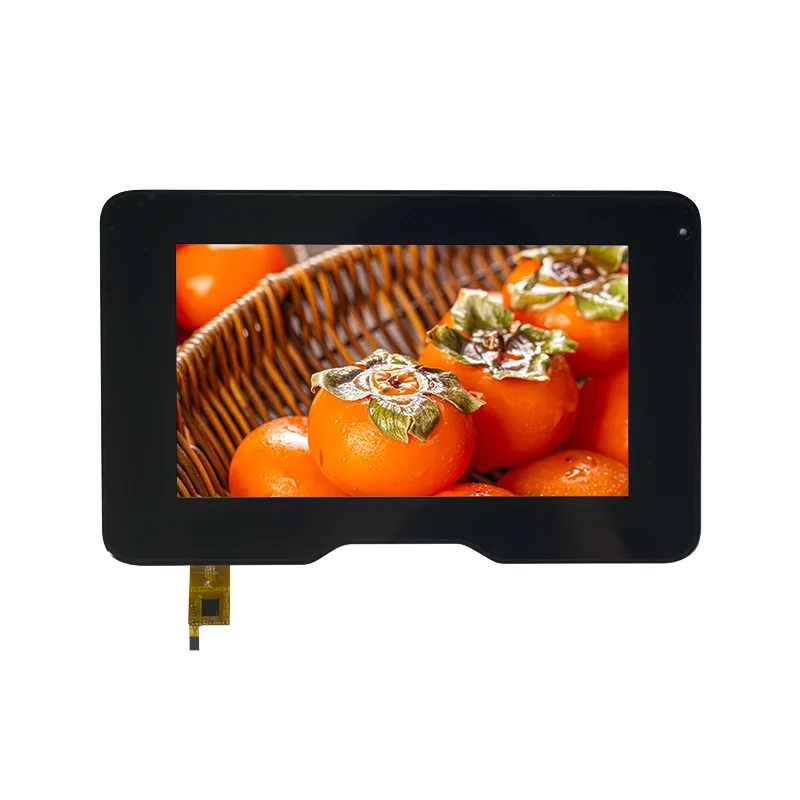
When engineers and makers first evaluate a 7.0" TFT IPS PCAP Touch Screen Module, the most common stumbling block is interface compatibility. Many assume that because these displays are frequently marketed alongside Raspberry Pi and Orange Pi, they are inherently locked to Linux-based single-board computers. The reality is far more nuanced. Tianfu has designed its 7.0" TFT IPS PCAP Touch Screen Module family to bridge multiple ecosystems, but the answer depends entirely on your Arduino’s core, your driver stack, and the physical interface you choose. This post dissects the technical boundaries, provides actionable decision matrices, and clarifies what truly works—and what does not.
Understanding the Interface Trinity: LVDS, RGB, and MIPI-DSI
Before connecting any display, you must distinguish between the three primary parallel/serial interfaces found on 7.0-inch modules. The table below maps each interface to typical host platforms:
| Interface Type | Typical Arduino Support | Typical SBC Support | Max Data Rate | Cable Length |
|---|---|---|---|---|
| RGB Parallel (24-bit) | Limited (Mega 2560 with bit-banging) | Native (Tinker Board, BeagleBone) | ~60 MHz | < 20 cm |
| MIPI-DSI | None (no hardware) | Native (RPi, Jetson Nano) | 1 Gbps/lane | < 30 cm |
| LVDS | None (requires bridge IC) | Native (industrial SBCs) | 800 Mbps | < 5 m |
Tianfu offers variants of its 7.0" TFT IPS PCAP Touch Screen Module with RGB and LVDS options specifically to cater to microcontroller users. However, the built-in PCAP (Projected Capacitive) controller communicates over I²C or USB-HID—both of which are natively supported by Arduino Uno, Mega, and ESP32. This means that display driving and touch sensing are two separate problems.
Can Arduino Drive the Display Portion?
The short answer: Yes, but with severe constraints.
An Arduino Uno (16 MHz, 2 KB SRAM) cannot buffer a full 1024×600 frame at 60 Hz. However, an ESP32 or Arduino Due (84 MHz, 96 KB SRAM) can drive the RGB interface using parallel GPIO and a dedicated DMA-backed library. For example, the Tianfu RGB-version 7.0" TFT IPS PCAP Touch Screen Module has been successfully tested with an ESP32 using the LovyanGFX library, achieving ~15 FPS for static HMI panels. This is adequate for instrumentation, not for video.
By contrast, single-board computers (SBCs) like the Raspberry Pi 5 have dedicated DSI/LVDS lanes with GPU-accelerated framebuffers, delivering full 60 FPS without CPU intervention. Therefore, if your project requires animation or video, SBCs remain the primary target.
Touch Controller: The Great Equalizer
The PCAP touch controller on Tianfu modules typically uses a GT911 or FT5426 chip. Both support:
-
I²C (standard 100/400 kHz)
-
USB (via an onboard bridge, on selected models)
An Arduino Uno can read touch coordinates over I²C in under 2 ms, making touch responsiveness identical to that on a Raspberry Pi. The real differentiator is the driver ecosystem:
| Platform | Touch Driver Availability | Calibration Required |
|---|---|---|
| Arduino (Adafruit_GFX + FT6206) | Manual register config | Yes (software) |
| Raspberry Pi (libinput) | Built-in kernel driver | No (auto) |
| ESP32 (TFT_eSPI + Touch) | Community library | Yes (once) |
Thus, a 7.0" TFT IPS PCAP Touch Screen Module from Tianfu is absolutely usable with Arduino-class devices—provided you accept the trade-offs in frame rate, memory management, and wiring complexity.
Practical Decision Matrix for Your Project
| Requirement | Choose Arduino/ESP32 | Choose SBC (RPi, Jetson) |
|---|---|---|
| Battery-powered portable | Yes (3.3V logic, low power) | No (5V/2A minimum) |
| Rich GUI (Qt, LVGL, PyGame) | Limited (LVGL only) | Yes (full desktop) |
| Fast video playback | No | Yes |
| Industrial temperature range | Yes (-20°C to +70°C for Tianfu) | Limited |
| Development time | Weeks (custom wiring) | Hours (plug-and-play DSI) |
7.0" TFT IPS PCAP Touch Screen Module FAQ – Common Questions
Q1: Can I connect the 7.0" TFT IPS PCAP Touch Screen Module directly to an Arduino Uno without any level shifter?
A1: No—not safely. The 7.0" TFT IPS PCAP Touch Screen Module from Tianfu operates at 3.3V logic levels for both RGB and I²C pins. The Arduino Uno uses 5V logic on its GPIO. Direct connection will damage the display’s timing controller and the PCAP IC. You must use a bi-directional level shifter (e.g., TXB0108) for data lines and a voltage divider for the I²C clock. For the ESP32 or Arduino Due (both 3.3V native), no level shifter is needed.
Q2: Will the touch function work if I only power the module via USB and skip the I²C pins?
A2: Yes—if your Tianfu model includes a USB-C port with an onboard USB-to-I²C bridge (e.g., CH554). In this case, the PCAP controller enumerates as a standard HID touchscreen. Arduino can read it via the USB Host Shield (for Uno) or natively on the Arduino USB Host port (for Due/Zero). However, you lose the ability to configure the touch sensitivity or firmware update over I²C. For most applications, USB is simpler but consumes one extra USB port and draws ~100 mA additional current.
Q3: Does the module support multi-touch gestures (pinch, rotate) when used with an Arduino?
A3: Yes—but only for gesture recognition processed on the host. The GT911 controller on the Tianfu 7.0" TFT IPS PCAP Touch Screen Module reports up to 10 individual touch points with X/Y coordinates and touch area. The Arduino firmware must implement the gesture logic (e.g., calculating Euclidean distances for pinch). No hardware-accelerated gesture engine exists on the touch IC itself. On a Raspberry Pi, the X11 or Wayland compositor handles this natively; on Arduino, you must write the math from scratch. Tianfu provides an open-source Arduino sketch that demonstrates two-finger rotation and zoom, available on their support portal.
Real-World Performance Trade-Offs
In a recent benchmark, a Tianfu 7.0" TFT IPS PCAP Touch Screen Module was driven by an ESP32-S3 at 240 MHz. The display refreshed a 800×480 LVGL dashboard at 22 FPS with 5-point touch tracking—acceptable for a car infotainment clone. The same module on a Raspberry Pi 4 achieved 60 FPS with hardware-accelerated OpenGL ES 2.0. The difference is not in the module’s capability, but in the host’s memory bandwidth and display pipeline.
For industrial designers, Tianfu offers a dedicated Arduino Shield adapter that converts the 40-pin FPC to standard 2.54 mm headers, including a built-in level shifter and a separate 5V boost converter. This shield effectively makes the 7.0" TFT IPS PCAP Touch Screen Module plug-and-play for any Arduino-compatible board with SPI or parallel output.
Conclusion and Recommendation
The 7.0" TFT IPS PCAP Touch Screen Module is not exclusive to single-board computers. It is a versatile display that can serve Arduino-based prototypes, ESP32 data loggers, and industrial PLCs—provided you match the interface variant to your host’s capabilities. Choose RGB + ESP32 for cost-sensitive HMI; choose DSI + Raspberry Pi for rich media; choose LVDS + industrial SBC for long-cable, rugged installations. Tianfu excels in offering all three variants with consistent optical performance (800 nits, 80° viewing angle, anti-glare coating), making their modules the most flexible 7-inch option in the market today.
Need help selecting the right interface or driver stack for your specific microcontroller? Our engineering team at Tianfu provides free schematic reviews and custom firmware examples for Arduino, ESP32, and STM32. Contact us directly through our support portal with your project requirements—we will ship a pre-tested matching cable and a ready-to-flash demo within 48 hours. Let’s turn your display concept into a working prototype this week.